



What is Box Header
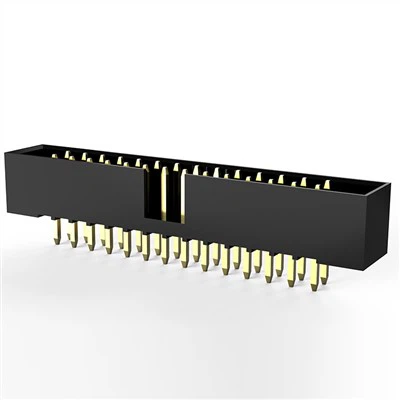
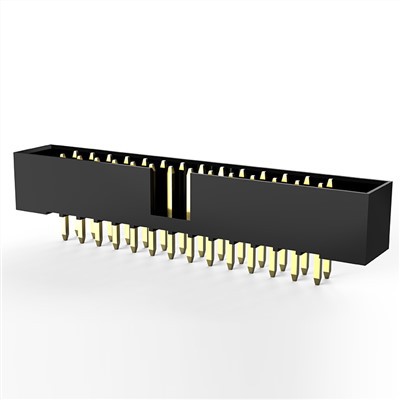
A box header is a male connector with exposed pins encompassed by side dividers which are molded onto a plastic base. Box headers are manufactured with a minimum of two pins in either single or double rows. They are widely used for board-to-board or wire-to-board connections.
Benefits of Box Header
Removable connections
Box headers allow for components to be easily attached and detached from a PCB without desoldering. This enables modifications, replacements, and changes.
Flexibility
A wide range of box header styles are available to accommodate various connectivity needs. Pin count, pitch, height, and other factors can be specified.
Reliability
Box header are designed for dependability and durability in demanding environments. Proper mating helps prevent disconnected wires.
Versatility
Box header have broad applications for connecting peripheral devices, wiring, cables, boards, and more. Standard interfaces enable versatility.
Serviceability
Wires and cables can be changed out or serviced without altering soldered connections on boards. This helps maintenance and repairs.
Cost-effectiveness
Box header connectors provide a budget-friendly interface option compared to costly custom connectors. They are widely available and reusable.




Product Categories
Latest Products


Why Choose us
Fast Delivery
CNT adopts auto-production, and auto-inspect & package machine which ensures the high quality and efficiency. Both small quantity and big quantity, CNT both could ensure the fast delivery time.
Quality Guaranteed
CNT has passed the certificate of quality system of ISO9001:2015 and IATF16949. All its materials have passed the certifications of ROHS, REACH, and UL.
Cutting-edge technology
CNT has self-owned lab which could full set testing from materials to finished products to guarantee the product quality.
Customer-focused
We prioritize the satisfaction of our clients and make sure their needs are met in a timely and effective manner.
Application of Box Header
Key Applications of Box Header in Industrial Displays

HMI and Panel Mount Displays
Human-machine interface (HMI) panels with integrated displays often use box header to link to:
Touchscreen controllers Display-integrated touchscreen sensors route through header pin connections to controller boards. This allows interchangeability.
Backlight drivers LED backlight power and controls route through box header from driver boards to displays.
Power Terminals Header pin power terminals enable easy connection of power from external sources to power boards.
Control Inputs External controls like switches route into displays via box header.
Communications Data cables joining to COM ports use header pin connections for transmission in and out of an HMI display.
Removable cabling through header pin interfaces enables simplified servicing and replacement of HMI components.
POS and Kiosk Displays
Point of sale (POS) systems and interactive kiosks depend on box header for:
Joining peripherals like barcode scanners, cash drawers, card readers, receipt printers, etc.
Connecting touchscreen overlay components.
Extending connections for power, video, and data to the main display/PC.
Linking small interconnect boards back to the main circuit assembly.
Being able to easily detach cables and components makes service and upgrades more straightforward for POS/kiosk systems.
Digital Signage and Video Walls
Video walls, menu boards, and digital signage use header pin connections to:
Link individual panels together into video wall configurations.
Connect external media players, video controllers, cameras.
Join peripherals like touch overlays, sensors, payment terminals, etc.
Extend power and data connections.
Easily swapping components in and out helps enable flexible digital signage arrangements.
Retail and Restaurant Displays
In retail locations, box header are key for:
Connecting peripherals like barcode/QR code scanners, card readers, scales, etc.
Linking self-service kiosks and price checkers.
Joining components of smart shelves, smart mirrors, and interactive displays.
Integrating lighting controls, sensors, security devices.
Providing standardized power and data termination points.
Being able to modify connections simplifies upgrades and maintenance for constantly evolving store technology.


Medical and Laboratory Displays
In medical devices and lab equipment, headers provide:
Sensor/probe connectivity into analysis instruments.
Touchscreen and user interface connections.
Video routing from endoscopes/cameras to displays.
Integration of analytical modules and additional hardware.
Swap-ability of components is crucial for adjusting medical/lab gear and keeping it updated.
Military and Marine Electronics
Rugged displays used in defense, aerospace, and marine settings depend on box header to enable:
Quick replacement of damaged display modules in the field.
Integration of varying modules like radios, tactical interfaces, GPS, etc.
Connecting peripherals and lights via standard interfaces.
Reliable power input connections.
Being able to rapidly reconfigure mission-critical systems under harsh conditions is essential.
Test and Measurement Equipment
For industrial test and measurement systems, headers provide:
Sensor connections from measurement probes.
Inputs for signals being analyzed.
Video outputs to integrated displays.
Links between stacked circuit boards.
Connections to data recorders and analyzers.
Headers enable extensive connectivity in complex measurement electronics.
Industrial Control and Automation
Box header used in industrial automation systems connect:
Inputs and outputs to/from PLCs and controllers.
HMIs and their integrated touch panels.
System components like drives, power supplies, safety controls, sensors, etc.
External circuits for power, controls, management, etc.
Removable connections aid troubleshooting and replacement of components in automation systems.
Smart Home Devices
Even in smart home devices and appliances, you will see headers used for:
Connecting integrated touchscreen panels.
Linking components like control boards, sensors, Wi-Fi modules.
Providing serviceability access to internal electronics.
Power and data ingress/egress.
Header pin usage spans the spectrum from complex industrial equipment down to consumer smart home tech.

What Are The Different Types Of Box Header?
Straight Pin Header
This is the most basic type of pin header, where the pins are straight and perpendicular to the header’ s base. They are commonly used for standard connections on circuit boards.
Right-Angle Pin Header
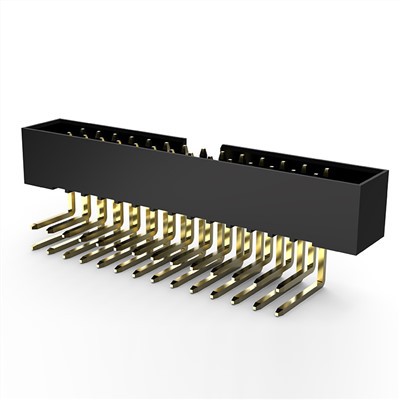
In this type, the pins are bent at a right angle to the header’s base. Right-angle pin headers are often used in applications where space is limited, or where connections need to be made perpendicular to the circuit board.
Surface Mount (SMD) Pin Header
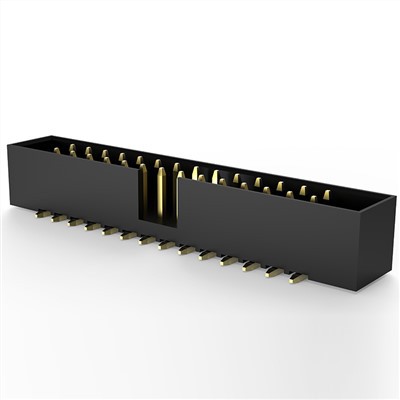
Surface mount pin headers are designed to be mounted directly onto the surface of a circuit board, rather than through holes. They are typically used in modern electronics manufacturing processes where space-saving and automated assembly are priorities.
Dual Row Pin Header
These headers have two rows of pins, allowing for a higher density of connections compared to single-row headers. They are commonly used in applications where a large number of connections are required in a compact space.
Stackable Pin Header
Stackable headers feature long pins that can be inserted into multiple headers, allowing for stacking of multiple boards or modules on top of each other. They are often used in applications such as prototyping and modular electronics.
Shrouded Pin Header
Shrouded headers have a plastic shroud or housing surrounding the pins, providing additional protection and stability. They are commonly used in applications where there is a risk of accidental contact with the pins.
Breakaway Pin Header
Breakaway headers consist of individual pins that can be broken off in groups to create headers of custom lengths. They offer flexibility in assembly and customization.
Wire-to-Board Pin Header
These headers are designed to connect wires to a circuit board, providing a secure and reliable connection for applications such as power supply and signal transmission.
What is the difference between pin header and Box Header?
Pin Header: A pin header typically consists of a row of pins arranged in a plastic housing. The pins are usually male and are designed to be inserted into a corresponding female box header or socket. Pin headers can be straight, right-angle, or surface mount, depending on the application.
Box Header: A box header is a more general term that encompasses a wider range of configurations. Box header can have male pins, female sockets, or a combination of both. They may include additional features such as locking mechanisms, polarization, and shielding. Box header can be used to join different components or modules together, allowing for easy assembly, disassembly, and maintenance.
Pin Header: Pin headers are often used for board-to-board connections, allowing for easy interfacing between circuit boards or modules. They are commonly found on development boards, expansion boards, and other electronic devices where modular construction or easy customization is required.
Box Header: Box header are used in a wide range of applications beyond board-to-board connections. They can be found in cables, wires, and various electronic devices to facilitate connections between different components or subsystems. Box header are often used for power supply, signal transmission, data transfer, and other purposes.
Pin Header: Pin headers are typically soldered onto a circuit board during assembly, providing a permanent and secure connection. They can also be press-fit or surface mounted, depending on the design and requirements.
Box Header: Box header may use soldering, crimping, or other termination methods to establish a connection. They can be attached to wires, cables, or other components, allowing for easy installation and replacement.
While both pin headers and box header facilitate electrical connections in electronics, they differ in their design, purpose, and application. Pin headers are primarily used for board-to-board connections and feature male pins arranged in a housing, while box header are more versatile and can be used in various configurations and applications beyond board-to-board connections.
What is the Spacing of Box Header?
2.54 mm (0.1 inches)
This is the most widely used pin pitch for general-purpose box header. It's commonly found in through-hole and surface-mount headers and is compatible with a wide range of connectors and prototyping boards.
2.00 mm
Box header with a 2.00 mm pitch offer higher pin density compared to the 2.54 mm pitch. They are used in applications where space-saving is a priority but may require connectors specifically designed for this pitch.
1.27 mm
Box header with a 1.27 mm pitch are commonly used in compact electronic devices and applications where miniaturization is important. They provide higher pin density than the 2.54 mm pitch but require connectors and components designed for this smaller pitch.
Others
There are also box header available with non-standard pitches for specialized applications. These may include pitches such as 1.00 mm, 2.50 mm, 3.00 mm, etc., though they are less common and may require custom connectors or components.
How To Choose Box Header Double Row
In electronic components, product design often has a strong correlation with its performance. Good design can not only improve the aesthetics of the product, but also extend the service life of the product, which is often used in the design. The choice of box header is also very important.
The box header can be divided into: single row, double row, 3 rows, 4 rows, and currently up to 4 rows.
The development of box header is becoming more and more miniaturized. Since many product faces have to face smaller and lighter development, there are certain requirements for the spacing and appearance, and the requirements for the products will be more precise, such as wire pairs. The better choice of the board is small pitch 0.6mm and 0.8mm, high density, high speed transmission, high frequency direction development.
Miniaturization means that the center of the box header is smaller, which is the PIN distance often mentioned in the industry. High density is the inevitable result of achieving large core number.
The role of the box header is to connect the circuit and take on the task of current or signal transmission. It is usually used in conjunction with the motherboard to form a board-to-board connection; or used in conjunction with a wire harness to form a board-to-wire connection; it can also be used independently for board-to-board connection. In order to prevent the electronic designers from underestimating the importance of single-row needles in the design process, we have made some suggestions for this because of the small loss. That is to have a two-bar design idea when designing; there is also a strong design and so on.
The raw materials in the box header are white and bright, and the color is between silver and nickel. The initial solderability is acceptable. The solderability is reduced when the temperature is high or the long-term storage is severe. The gold-plated bottom layer of the original ornament used for contact with the human body can also be used for the whiteness of the electrical performance, which is not required to have high resistance to color change, and has a certain weldability requirement.
Therefore, how do we choose the box header? People first consider the cost control, others are high quality, high stability, and the design features of the box header itself. In fact, to put it bluntly, the choice of box header is both durable and cost-effective, and it is also suitable for your own use. Therefore, alternative manufacturers have become an excellent choice. Not only is quality in place, but price is also a big advantage, and the greater advantage is reflected in the delivery date.
Our Factory
CNT was founded in 2007, specializes in design, produce and sale various kinds of electronic connectors: board to board connectors and board to wire connectors. Our products have been widely sold to Europe, Southeast Asia, Hongkong, Taiwan, Mainland China and other districts and countries.
CNT adopts auto-production, and auto-inspect & package machine which ensures the high quality and efficiency. Both small quantity and big quantity, CNT both could ensure the fast delivery time. CNT has passed the certificate of quality system of ISO9001:2015 and IATF16949. All its materials have passed the certifications of ROHS, REACH, and UL. The company has self-owned lab which could full set testing from materials to finished products to guarantee the quality.
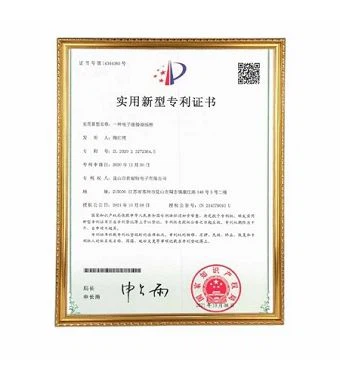
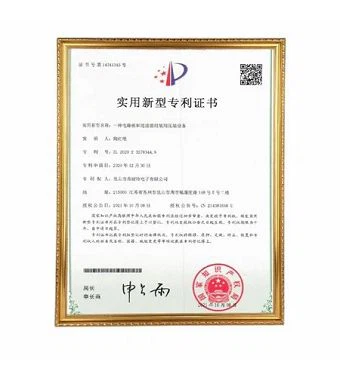
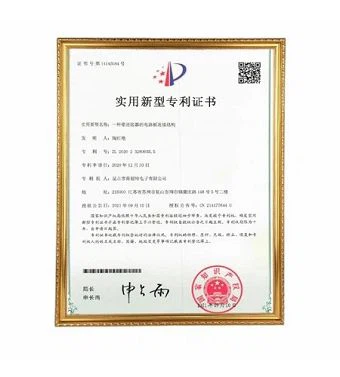
Our products are widely used in Industrial Instrument, Frequency Converter, Stereo Amplifier, CCTV, LED Screen, Smart Meters & Terminals, PCBA, Cell Phone, Househould Appliances, IoT, electric automobile and so on. CNT has obtained 15 national patents till now. And in 2022, CNT was awarded as National High-Tech Enterprise.


Our Certificate
ISO9001, IATF16949, ROHS, REACH, UL


Asked Questions
