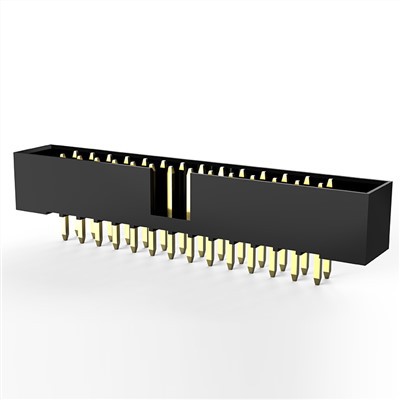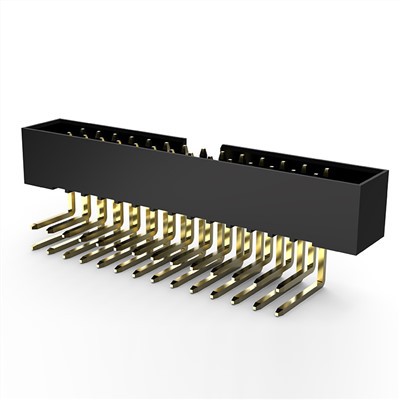


Applications
· Audio
· Video
· Scanner
· IoT
· Security equipment
· Monitor
Specifications
· Current Rating: 1A Max
· Insulation Resistance: 1000MΩ Min
· Dielectric Withstanding: 300V AC
· Contact Resistance: 20mΩ Max
· Operating Temperature: -40°C - +105°C
· Solderability: Reflow capable up to 260°C
Materials
· Plating: Gold flash(0.8”) Standard
Higher gold available
Tin
· Contact Material: Cooper Alloy
· Housing Material: High-temperature Thermoplastic
· Environmental: UL94 V0
Others
· 2D drawing
· Contact CNT to get 3D file
· RoHS & REACH compliant
· UL compliant

Features
● Good resistance to breaking
● Improved durability
● help to minimize electromagnetic interference (EMI), which can negatively impact the performance of a system.
● High reliability and durability
Advantages
● Can be used in a wide range of industries and applications, including telecommunications, automotive, industrial, and consumer electronics.
● Be used in high-vibration environments, reducing the risk of disconnection.
● Traceability of Order and raw material
● Systematic lab testing ability
● Mechanized production, stable quality
● Complete product range, full pitch series
Kunshan Connector Electronics Ltd.(CNT) has been devoted to the production and sale of electronic connectors for 16 years, adhering to the belief of quality first and customer first. CNT is a reliable manufacturer in 0.1 pin header connector with high quality and best price. We focus on providing high value products to our customers including male header, female header, box header, wafer, FPC, RJ and wiring harness. Any demand in 0.1 pin header connector, welcome you to contact us. Just call or send email to us to get professional support, believe that CNT will be your best business partner!
Packaging and Shipping


Inspection Equipment


Our Certificate

Q&A
How do you choose the right board-to-board connector for your application?
Choosing the right board-to-board connector for an application involves several considerations. Here are some factors to keep in mind:
Pitch: The pitch refers to the distance between the center of one contact to the center of the next contact. Make sure to select a connector with a pitch that matches the spacing of the pads on the boards.
Number of contacts: Consider the number of connections required for your application. Choose a connector that has the appropriate number of contacts.
Current rating: Ensure that the connector can handle the current required by your application.
Voltage rating: Make sure the connector can handle the voltage level of your application.
Signal integrity: If you are dealing with high-frequency signals, consider using connectors with impedance matching capabilities to maintain signal integrity.
Mounting: Consider the available space and the ease of installation. Some connectors may require surface mount technology (SMT) while others may be through-hole.
Environmental factors: Consider factors such as temperature, humidity, and vibration that could impact the connector's performance. Choose a connector that is designed to handle the environmental conditions of your application.
Cost: Finally, consider the cost of the connector and whether it fits your budget.
By carefully considering these factors, you can select a board-to-board connector that is appropriate for your application.
What are the different materials used for board-to-board connectors?
1)Metals: Metals are often used in board-to-board connectors due to their durability and conductivity. Copper, brass, and phosphor bronze are all common materials used for the contacts in board-to-board connectors.
2)Plastics: Plastics are commonly used in board-to-board connectors due to their light weight and versatility. PBT, nylon, and LCP are all materials that are often used for the housing or insulating components of board-to-board connectors.