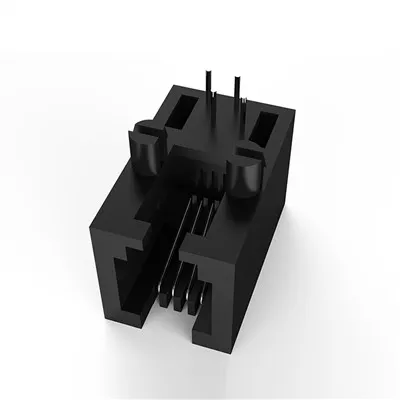


Applications
· Instrumentation and test equipment
· Medical equipment
· Office equipment
· Home appliances
· Material handling equipment
· Building and home automation
· Industrial controls
· Robotics
Specifications
· Current Rating: 1A Max
· Insulation Resistance: 1000MΩ Min
· Dielectric Withstanding: 300V AC
· Contact Resistance: 20mΩ Max
· Operating Temperature: -40°C - +105°C
· Solderability: Reflow capable up to 260°C
Materials
· Plating: Gold flash(0.8”) Standard
Higher gold available
Tin
· Contact Material: Cooper Alloy
· Housing Material: High-temperature Thermoplastic
· Environmental: UL94 V0
Others
· 2D drawing
· Contact CNT to get 3D file
· RoHS & REACH compliant
· UL compliant

Features
● Improved noise immunity
● Increased contact force
● Faster installation
● Improved system availability
Advantages
● Systematic lab testing ability
● Mature R&D team
● Skilled and stable staff
● Good before-sales and after-sales service
Kunshan Connector Electronics Ltd.(CNT) has been devoted to the production and sale of electronic connectors for 16 years, adhering to the belief of quality first and customer first. CNT is a reliable manufacturer in 8 pin female header connectors with high quality and best price. We focus on providing high value products to our customers including male header, female header, box header, wafer, FPC, RJ and wiring harness. Any demand in 8 pin female header connectors, welcome you to contact us. Just call or send email to us to get professional support, believe that CNT will be your best business partner!
Packaging and Shipping


Inspection Equipment


Our Certificate

Q&A
What are the common types of termination methods for board-to-board connectors?
There are several common types of termination methods for board-to-board connectors, each of which has its own advantages and disadvantages depending on the specific application. Here are some of the most common types of termination methods:
1)Through-hole termination: In this method, the connector is mounted onto the PCB using pins that pass through holes in the board. The pins are then soldered onto the board, providing a secure mechanical and electrical connection. Through-hole termination is typically used for larger connectors, or where high mechanical stability is required.
2)Surface-mount termination: In this method, the connector is mounted onto the surface of the PCB using solder paste and a reflow soldering process. Surface-mount connectors are typically smaller and lighter than through-hole connectors, making them a good choice for applications where space is limited or weight is a concern.
3)Press-fit termination: In this method, the connector is pressed into holes in the PCB, creating a gas-tight mechanical and electrical connection without the need for solder. Press-fit connectors are often used in high-reliability applications where frequent rework is required, since they can be removed and replaced without damaging the PCB.
4)Wire-to-board termination: In this method, wires are terminated onto the connector using crimping, soldering, or insulation displacement techniques. Wire-to-board connectors are often used in applications where flexible wiring is required, such as in automotive or industrial control systems.
5)Board-to-board stacking: This method involves stacking one PCB on top of another, with the connectors on each board interconnecting with each other. Board-to-board stacking connectors are often used in applications where high-density interconnects are required, such as in server or telecom systems.
Each of these termination methods has its own advantages and disadvantages, and the specific method chosen will depend on the requirements of the application. When selecting a connector, it's important to consider factors like the size and weight of the connector, the number of contacts required, and the required level of mechanical and electrical stability.
What are the different types of board-to-board connector systems available?
1)Board-to-board stacking connectors: These connectors are designed to connect two PCBs together in a stacked configuration. They typically have a low profile and are designed to provide a reliable, high-speed connection.
2)Board-to-board mezzanine connectors: These connectors are similar to stacking connectors, but are typically used to connect two PCBs in a parallel configuration, with one PCB mounted on top of the other. They are commonly used in high-density applications where space is limited.